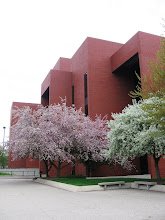
Renovation of the Science-Health Science Library at Ball State University

I overheard one student describe the Science-Health Science Library (SHSL) as one of the best-kept secrets on campus. The reason for this student’s observation is that the SHSL provides a unique, quiet study atmosphere, an availability of key resources for learning and study, and a full-service circulation point on the west side of campus making it a favorite of students and faculty.
Occupying nearly 1,500 square feet, the SHSL is a distinctive learning space located in the exact center of the lower level of Cooper Science Building. It is surrounded by offices and classrooms, a large two-story electronic classroom and lecture hall, and hallways. And it is off the beaten path. Yet, over the past five years and without any additional space, the SHSL has undergone a number of changes that have increased the functionality of its space to serve more students and faculty in a more effective and efficient manner.
Our enhanced service has been accomplished by selectively re-prioritizing the collections, which has increased its efficiency and impact. Refocusing of the collection has included relocating many of the less circulated books and some bound journal volumes to Bracken, the University’s main library. Many journal print titles, only available when the SHSL is open, have been replaced with convenient, 24/7 online access. The stacks that were previously used for these print materials have been repurposed to provide services for students and faculty who come to the library. This has not gone unnoticed.
Professor Nagia S. Ali, School of Nursing, remarks that the SHSL is “Beautiful. It will encourage people to come in and find articles, sit and have a nice place to study. It’s always a quiet place to study.”
A comfortable and inviting décor of tables and soft-chair seating has been added to support collaborative and individual study. These improvements have increased the area’s seating capacity to 29. According to turnstile counts, traffic in the area has experienced an accelerating growth pattern from 32,723 during fiscal year 2004-2005 to 42,064 at the end of this past fiscal year 2006-2007 that ended June 30, evidencing an increase of 28.5% over a two-year period.
Beginning in early June 2007, the library’s space underwent another renovation that was focused on streamlining the library’s floor plan. This was undertaken to make better use of the space through additional seating and access to more public PC workstations.
The library’s circulation counter was replaced and a new one was positioned opposite the library’s entrance and visible from the hallway whereas the former counter was located adjacent to the entrance and not visible from the hallway. Changing the location and size of the counter opened a large amount of space that has been used for making available additional PC work stations and seating. The SHSL now offers 34 seats and 12 PC workstations.
“I love this library. You’ve got lots more room but can still find things easily. I can see the current periodicals now. It looks so smashing,” said Fresia E. Steiner, Research Associate, Public Health Entomology Lab, Department of Physiology and Health Science.
The new location for the circulation desk also means that library personnel are able to monitor the front area of the library better. This allows the staff to provide better and more timely service to our users. Visual relief will be further enhanced by replacing a full-sized range of shelving with a 36” half-size section of shelving with a counter top to house reference materials, making these items more accessible and usable to everyone. “Very nice,” says Professor Scott E. Pattison, Department of Chemistry. “Much more room. The students will certainly benefit.”
Professor James C. Eflin, Chair, Department of Natural Resources and Environmental Management, commented that the SHSL is “… very open — much more inviting for students entering the library.”
An additional heartening comment about the SHSL renovation comes from Cheryl H. Kellogg, Instructor of Biology, Indiana Academy for Mathematics, Science, and Humanities. Cheryl relates, “I love this place. When I die and go to heaven I want it to be like the Science Library.”
SHSL services include providing course reserves (paper and electronic), research consultation, a public copy machine, color scanner, instruction on finding and evaluating information and its sources, and online resources at the library’s website, www.bsu.edu/library/collections/shsl.
For more information, contact Kevin E. Brooks, Ball State University Libraries’ Science Librarian, (765) 285-5079 or KBrooks2@bsu.edu.
Labels: Architecture Library, Ball State University Libraries, branch, renovation
posted by Ball State University Libraries @ 2:52 PM
0 comments