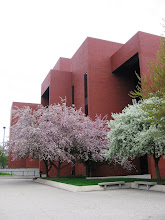
Helen B. and Martin D. Schwartz Special Collections and Digital Complex Dedication Held in Bracken Library


The Helen B. and Martin D. Schwartz Special Collections and Digital Complex on the first floor of the Alexander M. Bracken Library was dedicated at 11:00 a.m. on August 17, 2009. The 30-minute ceremony included remarks from Ball State President Jo Ann Gora, Vice President for Information Technology Phil Repp, Dean of University Libraries Arthur Hafner, and Mr. Martin Schwartz.
The event was attended by Schwartz family members and friends and members of the Libraries and University administrations. Following the dedication ceremony, which included a short tribute video recognizing the Schwartz family for their long history of support of Ball State University and especially the University Libraries, guests toured the facility to see demonstrations of the technology and resources available in the areas of the Digital Complex.
The Schwartz Digital Complex is an innovative, collaborative, and interactive learning and teaching environment dedicated to serving the educational advancement of Ball State University students. This technology-rich facility in Bracken Library was made possible by a generous gift from Martin Schwartz in honor of his late wife, Helen.
In her remarks, President Gora said, “None of this would have been possible without the vision and philanthropic support of Helen B. and Martin D. Schwartz.” According to Vice President Phil Repp, the Schwartz Digital Complex will be “Ball State’s connection to the world, as well as the world’s connection to our unique collections, the kind of collections that Helen and Martin worked so hard to recognize and preserve.”
The Schwartz Digital Complex will provide a space that digitally connects students and faculty to the numerous digital media assets and special collections available through the University Libraries. It will be a place for students and faculty to reach across the globe to better understand the stories and customs of world cultures through digital media.
While making available the University Libraries’ rich array of digital media assets and special collections, the Complex also will provide access to media from around the world — a digital “newsstand” that provides access to international media, broadcasts, podcasts, and multimedia. It will be a global gallery that provides students and faculty with a media-rich gateway to connect visually and aurally to the artifacts that form the world’s cultures and societies. The Complex will also serve as an innovative and flexible space for fostering an undergraduate research culture.
The official opening of the Schwartz Digital Complex will be on September 17 as part of the first in a five-part series of Tech4U events sponsored by Information Technology and hosted in Bracken Library. The September 17 event will run from 10:00 a.m. to 2:00 p.m. and is open to the public.
Copies of the DVD of the dedication ceremony and tribute video are available for viewing in Archives and Special Collections, and will soon be available on the University Libraries’ Web site, www.bsu.edu/library.
For more information, contact John B. Straw, Assistant Dean for Digital Initiatives and Special Collections, JStraw@bsu.edu, 765-285-5078.
Labels: Bracken Library, Martin Schwartz, schwartz digital complex, technology, use of technology on campus
posted by Ball State University Libraries @ 2:45 PM
0 comments